

Sergeant Back Again—The Anthology of Critical and Clinical Commentary
by Charles A. Coleman, Jr.
Featured Books
Sergeant Back Again
Author: Charles A. Coleman, Jr.
Charles Coleman is the author of Sergeant Back Again, “the cult-classic Vietnam War novel that “made PTSD real!” Originally published by Harper & Row in 1980, it is now available in a new publication from PTSD PRESS: Sergeant Back Again: The Anthology of Critical and Clinical Commentary, contains the first-ever collection of published critical and clinical writings regarding the earliest characterizations and manifestations of combat-related post-traumatic stress disorder (PTSD) on and off the battlefield using a Vietnam novel as the catalyst for investigation, discussion, and analysis.
Key Themes
01.
Trauma & PTSD
The essay explores how war continues long after the battlefield ends, affecting veterans through memory, guilt, loss, and psychological injury.
02.
Two Perspectives, One War
American and Vietnamese experiences are contrasted to reveal how different sides of the same conflict can produce profoundly different narratives.
03.
Memory & Storytelling
Both novels use recollection and fragmented memories to reconstruct the reality of war.
04.
Hearts and Minds
The essay questions military, political, and personal interpretations of “winning hearts and minds” during and after conflict.
04.
Develop
05.
Deploy
06.
Deliver
REVIEW BY GEORGE KEARNS, HUDSON REVIEW, 1981
“The strongest, best-written novel by a new writer I have seen for a very long time is Charles Coleman’s “Sergeant Back Again.” Coleman, who served in the Army Medical Corps and later in the mental wards at Chambers Pavilion, Fort Sam Houston, the scene of his book, tells us in the Foreword: “I did not make this story: it came to me that way, ready-made, defined by historical circumstances, generated by the soldiers who have had to fight the most insidious and intimate battle: the one with yourself. . . . In writing this book I am mainly a chronicler who was left no choice but to try to speak for the inarticulate, the psychically scarred, and the wasted . . . . It is a synthesis of personal experiences, observations, interviews, and journals here woven together into a narrative.”
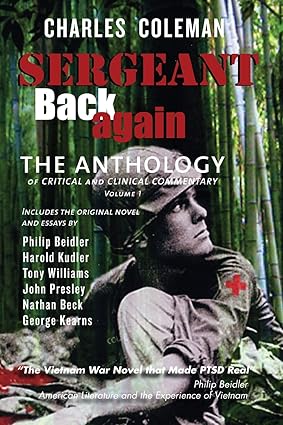
Sergeant Back Again—The Anthology of Critical and Clinical Commentary
Focusing on the central characters and actions dramatized in Charles Coleman’s universally-acclaimed portrayal of PTSD embodied in his Vietnam War-era cult classic, Sergeant Back Again (re-released in 2010), six highly-respected scholars, historians, and psychiatrists “weigh in” on the social, political, and medical aspects and consequences of the emergence of post-traumatic stress disorder during the Vietnam War Era and later manifested in troops returning from Iraq and now Afghanistan. It also sheds light on the reasons behind the escalation of veteran suicides, divorces, spousal abuse, drug and alcohol addiction, and homelessness. This is clearly a first in deconstructing the causes and effects of PTSD on U.S. Servicemen and women (with the formal diagnosis of PTSD having been first published by the psychiatric leadership in this country in 1980), based on the case of Specialist Andrew Collins, a line medic and later a surgical specialist who served in Vietnam. It puts Sergeant Back Again into perspective as “The Vietnam War novel that made PTSD Real!” (Philip Beidler, Ph.D.)
Skillfully analyzing scenes on the battlefield, the surgical unit and into the closed wards of Chambers Psychiatric Pavilion at Fort Sam Houston and the psychological milieu of both the patients and staff during 1970, psychiatrist Harold Kudler, M.D. explores the military medical establishment’s dilemma in trying to understand veterans returning from Vietnam and the attempts to classify and “treat” them in both the “old” conventional language of psychiatry and the bio-medical vocabulary in which “psychiatrists could no longer see the person under their care. Now, thirty years after arriving at a definition of PTSD based on the surface of behavior, Psychiatry is still struggling to see beyond abstractions in order to find the patients it left behind and the real heart of darkness that defines psychological trauma.” Sergeant Back Again: The Anthology of Critical and Clinical Commentary is the perfect companion piece to Coleman’s PTSD and Hemingway’s “A Way You’ll Never Be”: The Mark of Confidence.
Visuals
One War, Many Wars
- American War
- Vietnam War
- Civil War dimension
- Competing narratives
“How many wars comprised the Vietnam War?”
The Heart of War
Kien and Phuong imagery
- Love
- Survival
- Battlefield experience
- Vietnamese perspective
The Mind of Warriors
- PTSD
- Memory
- Flashbacks
- Psychological collapse
This reflects the article’s emphasis on Chambers Pavilion and psychological trauma.