
PTSD and Hemingway’s “A Way You’ll Never Be”: The Mark of Confidence
by Charles A. Coleman, Jr.
Featured Books
The Sorrow of War
Author: Bao Ninh
A deeply personal account of the Vietnam War from the perspective of a North Vietnamese soldier. Through protagonist Kien, the novel captures the emotional devastation of war and its lingering psychological effects.
Sergeant Back Again
Author: Charles A. Coleman Jr.
An acclaimed Vietnam War novel following Specialist Andrew Collins, a medic struggling with psychological trauma while confined to an Army psychiatric ward. The novel examines PTSD, memory, and the difficult journey toward healing.
Key Themes
01.
Trauma & PTSD
The essay explores how war continues long after the battlefield ends, affecting veterans through memory, guilt, loss, and psychological injury.
02.
Two Perspectives, One War
American and Vietnamese experiences are contrasted to reveal how different sides of the same conflict can produce profoundly different narratives.
03.
Memory & Storytelling
Both novels use recollection and fragmented memories to reconstruct the reality of war.
04.
Hearts and Minds
The essay questions military, political, and personal interpretations of “winning hearts and minds” during and after conflict.
04.
Develop
05.
Deploy
06.
Deliver
REVIEW BY GEORGE KEARNS, HUDSON REVIEW, 1981
“The strongest, best-written novel by a new writer I have seen for a very long time is Charles Coleman’s “Sergeant Back Again.” Coleman, who served in the Army Medical Corps and later in the mental wards at Chambers Pavilion, Fort Sam Houston, the scene of his book, tells us in the Foreword: “I did not make this story: it came to me that way, ready-made, defined by historical circumstances, generated by the soldiers who have had to fight the most insidious and intimate battle: the one with yourself. . . . In writing this book I am mainly a chronicler who was left no choice but to try to speak for the inarticulate, the psychically scarred, and the wasted . . . . It is a synthesis of personal experiences, observations, interviews, and journals here woven together into a narrative.”
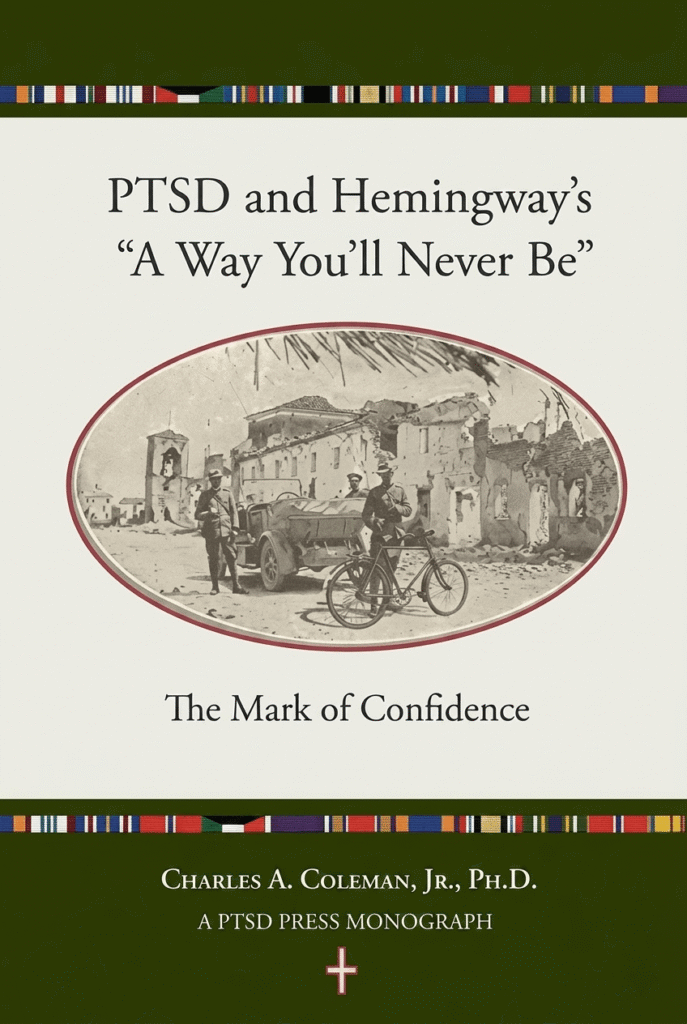
PTSD and Hemingway’s “A Way You’ll Never Be”: The Mark of Confidence
Hemingway’s short story, “A Way You’ll Never Be,” was published in 1933, forty-seven years before post-traumatic stress disorder (PTSD) was first defined and acknowledged as a mental health disorder by the American Psychiatric Society in its 1980 release of the Diagnostic and Statistical Manual of Mental Disorders (DSM). And yet, as Charles Coleman so astutely conveys in this in-depth analysis: “Ernest Hemingway described the symptoms of PTSD—and the inner workings of soldiers’ minds so afflicted—decades before post-traumatic stress disorder (PTSD) was recognized as a clinical condition. So striking are his depictions of ‘stressors’ and their effects upon his protagonist that discernible ‘patterns of affliction’ can be identified and actually tracked through the mental meanderings of Nicholas Adams in portraying situations, symptoms and manifestations of ‘the disorder’ that mirror today’s quest to better understand both PTSD and traumatic brain injury or TBI.
Far from “emotion recollected in tranquility,”5 Nick opens the short story with the signature signs of PTSD frequently occurring with an inventory of memorable minutia and often catalogued in the mind of the afflicted with tedious repetition. Frequently triggered by a stressor, these inventories are spontaneously generated from memory but are just as often unreliable once applied to the factual chronology of actual events. Additionally, people suffering from PTSD create various types of cerebral timelines, sometimes as simple as short vignettes of loosely connected mental pictures, some with action, speech, soundtracks, words, and associated odors. But these timelines are really just disconnected snippets of memories and not always accurate nor sequential and so do not conform to the more traditional definition of timeline as a way of describing and displaying a list of events in a strict chronological sequence or order. Timelines, along which key events are posted, are sometimes referred to as project artifacts (“using art” + “something made”) in which events and milestones are highlighted and enumerated in a graphic design displayed along a time bar.
Nicholas Adams begins stockpiling his memorable minutia with his inventories of the dead and their associated artifacts starting with “papers” and “paper” (at the end of the second paragraph) that are repeated in each of the two following paragraphs intermixed with “postcards,” “cards,” “photographs,” “pictures,” and “the letters, letters, letters” of the dead.
PTSD and Hemingway’s “A Way You’ll Never Be”: The Mark of Confidence is the perfect companion piece to Coleman’s Sergeant Back Again: The Anthology of Critical and Clinical Commentary.
Visuals
One War, Many Wars
- American War
- Vietnam War
- Civil War dimension
- Competing narratives
“How many wars comprised the Vietnam War?”
The Heart of War
Kien and Phuong imagery
- Love
- Survival
- Battlefield experience
- Vietnamese perspective
The Mind of Warriors
- PTSD
- Memory
- Flashbacks
- Psychological collapse
This reflects the article’s emphasis on Chambers Pavilion and psychological trauma.